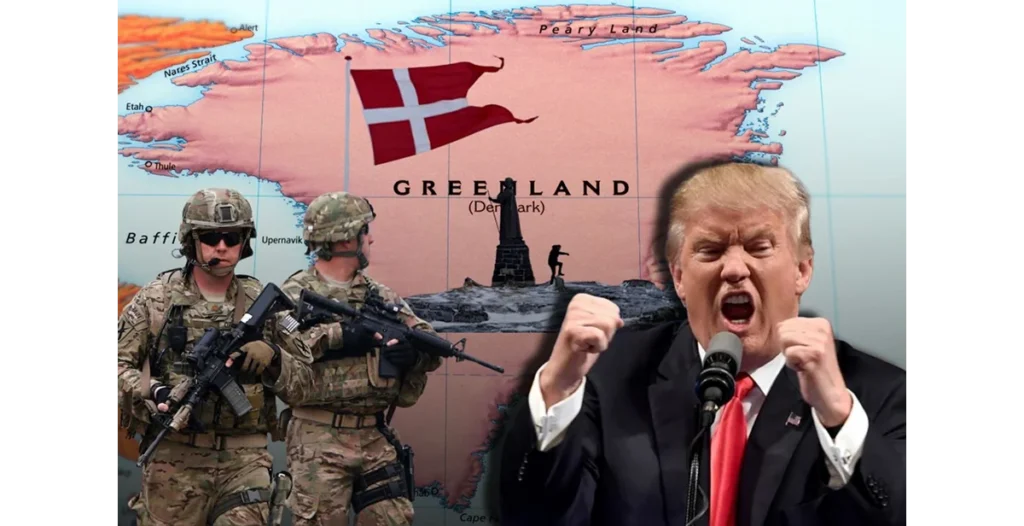
US Says Military ‘Always an Option’ in Greenland as Europe Pushes Back
7 January 2026 | Washington / Copenhagen
The United States has openly stated that a US military option in Greenland remains under consideration, triggering sharp reactions from European allies and renewed concerns within the NATO alliance. The White House said President Donald Trump views acquiring Greenland as a strategic priority, citing national security interests in the rapidly militarising Arctic region.
In a statement released on Tuesday, the White House confirmed that discussions are ongoing within the administration about ways to secure control over the autonomous Danish territory. “The president and his team are discussing a range of options to pursue this important foreign policy goal, and of course, utilizing the US military is always an option at the commander-in-chief’s disposal,” the statement said, underlining that a US military option in Greenland has not been ruled out.
Greenland, the world’s largest island with a population of about 57,000, is a self-governing territory within the Kingdom of Denmark. Any attempt to seize it by force would mark an unprecedented escalation between long-standing NATO partners.
Strategic interests revive Trump’s Greenland focus
Trump’s renewed interest in Greenland echoes his first-term proposal in 2019, when he publicly floated the idea of purchasing the island. That suggestion was swiftly rejected by both Denmark and Greenland. The issue has resurfaced amid heightened geopolitical competition in the Arctic, where melting ice has opened new shipping routes and access to natural resources.
The White House argues that a US military option in Greenland is linked to concerns over growing Russian and Chinese activity in Arctic waters. Trump has repeatedly claimed that Denmark lacks the capacity to adequately defend the territory, assertions that Copenhagen has firmly denied.
US officials say control over Greenland would enhance missile defence capabilities and protect strategic sea lanes in the North Atlantic. However, analysts warn that pursuing a US military option in Greenland could severely undermine alliance cohesion at a time when NATO is already strained by multiple global crises.
Europe and Canada reaffirm Greenland’s sovereignty

European leaders responded swiftly to the White House remarks. France, Germany, Italy, Poland, Spain and the United Kingdom issued a joint statement alongside Danish Prime Minister Mette Frederiksen, asserting that Greenland “belongs to its people” and that its future can only be decided by Denmark and Greenland.
“It is for Denmark and Greenland, and them only, to decide on matters concerning Denmark and Greenland,” the leaders said, rejecting any external pressure or threat involving a US military option in Greenland.
Canada also voiced support for Greenland and Denmark. Prime Minister Mark Carney announced that Governor General Mary Simon, who is of Inuit heritage, along with Foreign Minister Anita Anand, would visit Greenland next month as a show of solidarity.
Nordic foreign ministers from Finland, Iceland, Norway, Sweden and Denmark echoed the message, stressing Greenland’s right to self-determination. They also highlighted increased regional investments in Arctic security and expressed willingness to work with the US through NATO rather than unilateral measures.
NATO concerns and Greenland’s response
Polish Prime Minister Donald Tusk warned that any threat against a NATO member undermines the alliance’s credibility. “No member should attack or threaten another member of the North Atlantic Treaty Organisation,” he said, adding that such actions would weaken NATO’s core principles.
Greenland Prime Minister Jens-Frederik Nielsen welcomed Europe’s unified stance and urged Washington to engage in “respectful dialogue”. Greenland’s government has consistently opposed becoming part of the United States and has reiterated that its people do not support any US military option in Greenland.
Denmark has also pushed back against claims that it cannot safeguard the island. Foreign Minister Lars Lokke Rasmussen dismissed suggestions of heavy Chinese or Russian military presence in Greenland, saying the US was welcome to increase economic investment instead.
Meanwhile, Greenland’s government has sought an urgent meeting with US Secretary of State Marco Rubio to discuss rising tensions linked to the US military option in Greenland and to prevent further escalation.
Diplomatic tensions remain high
Adding to the controversy, Louisiana Governor Jeff Landry, recently appointed as US special envoy to Greenland, said he was not interested in engaging with Danish or European officials. Instead, he expressed a desire to speak directly with Greenland’s residents about economic development, remarks that were met with scepticism in Copenhagen.
As diplomatic exchanges continue, European leaders remain firm that Greenland’s status is not negotiable. While Washington insists that security concerns justify keeping a US military option in Greenland on the table, allies warn that pursuing such a path could fracture transatlantic trust and destabilise the Arctic region.
For now, Greenland’s leaders and its European partners are pressing for dialogue over confrontation, signalling that any attempt to impose a US military option in Greenland would face unified resistance.