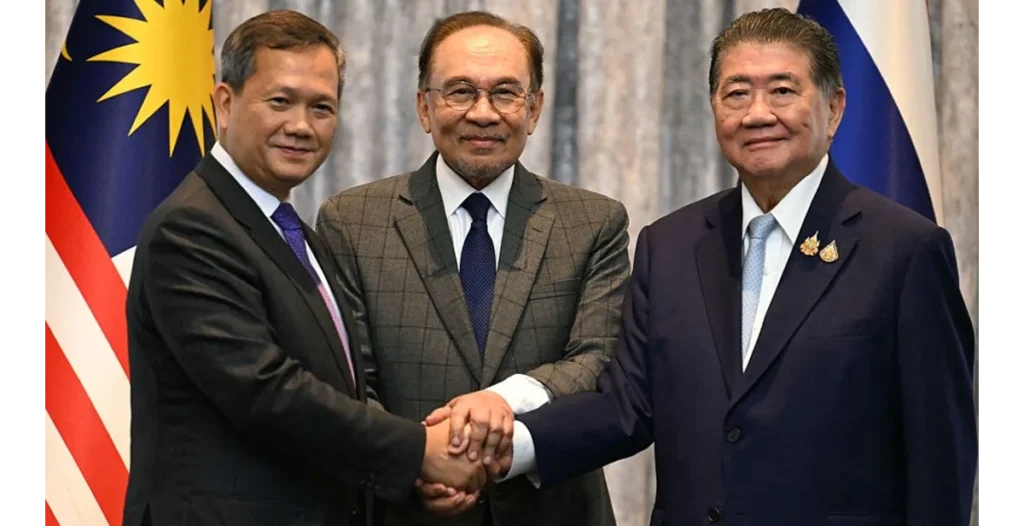
Thailand–Cambodia Ceasefire Agreement Reached, Ending Weeks of Intense Border Fighting
Thailand and Cambodia on Saturday agreed to an immediate ceasefire, bringing a halt to weeks of intense fighting along their shared border that left more than 100 people dead and displaced over half a million civilians on both sides. The Thailand Cambodia ceasefire was announced following high-level talks between defence officials, amid mounting regional and international concern over the escalating conflict.
In a joint statement issued after the signing, the defence ministers of both countries confirmed that the Thailand Cambodia ceasefire would take effect from noon local time on December 27. The agreement is aimed at restoring calm after nearly three weeks of sustained clashes, marking the worst confrontation between the two Southeast Asian neighbours in several years.
“Both sides agree to an immediate ceasefire after the time of signature of this Joint Statement,” the ministers said. They added that existing troop positions would be maintained, with no further movement by either side.
What the Thailand Cambodia ceasefire agreement includes
The Thailand Cambodia ceasefire covers all forms of military engagement along the disputed border areas. According to the joint statement, the agreement applies to “all types of weapons” and explicitly prohibits attacks on civilians, civilian infrastructure, and military targets across all affected regions.
The ceasefire was signed by Thai Defence Minister Natthaphon Narkphanit and Cambodian Defence Minister Tea Seiha after prolonged negotiations that followed repeated failed attempts to de-escalate the situation. Officials on both sides acknowledged that sustained fighting had caused significant humanitarian distress, prompting urgency to reach an understanding.
The agreement also includes provisions for monitoring compliance through existing military communication channels. While no third-party monitoring mechanism was announced, both governments said they would maintain close coordination to prevent violations of the Thailand Cambodia ceasefire.
Background to the border conflict

The latest clashes began around 20 days ago following renewed tensions along contested stretches of the Thailand-Cambodia border, an area that has witnessed periodic flare-ups over the past decades. This time, however, the fighting escalated rapidly, involving artillery fire and air operations that forced large-scale evacuations.
In Cambodia, residents from parts of Siem Reap province were among those displaced, with state media releasing images of civilians fleeing their homes amid air strikes. On the Thai side, authorities ordered evacuations in border villages as fighting intensified.
Officials from both countries blamed each other for initiating hostilities, with Cambodia accusing Thailand of heavy bombardment and Thailand citing security threats along the frontier. Despite intermittent talks earlier this month, violence continued, raising fears of a prolonged conflict before the Thailand Cambodia ceasefire was finally secured.
Humanitarian impact and regional concern
The fighting resulted in more than 100 fatalities and the displacement of over 500,000 civilians, according to official estimates. Temporary shelters were set up in both countries to accommodate those fleeing the violence, while humanitarian agencies warned of strained resources and growing needs.
The scale of the crisis drew attention from regional partners and international observers, who urged restraint and dialogue. Analysts noted that prolonged instability along the border could have wider economic and security implications for the region, particularly given the close trade and tourism links between Thailand and Cambodia.
The Thailand Cambodia ceasefire is expected to ease immediate humanitarian pressures, allowing displaced families to begin returning home once security conditions permit. However, authorities have cautioned that the situation remains fragile and will require sustained engagement to ensure lasting calm.
Next steps after the Thailand Cambodia ceasefire
Both governments said Saturday’s agreement was a first step toward broader efforts to resolve underlying disputes. Diplomatic sources indicated that follow-up meetings would focus on confidence-building measures and mechanisms to prevent future escalations.
While the Thailand Cambodia ceasefire has been welcomed as a significant breakthrough, observers stress that durable peace will depend on continued dialogue and adherence to the terms of the agreement. Any violations could quickly undermine trust built during the negotiations.
For now, the ceasefire offers relief to thousands affected by the conflict and signals a shared willingness by Bangkok and Phnom Penh to step back from confrontation. As the agreement takes hold, attention will turn to whether both sides can translate the Thailand Cambodia ceasefire into a longer-term framework for stability along one of Southeast Asia’s most sensitive borders.